
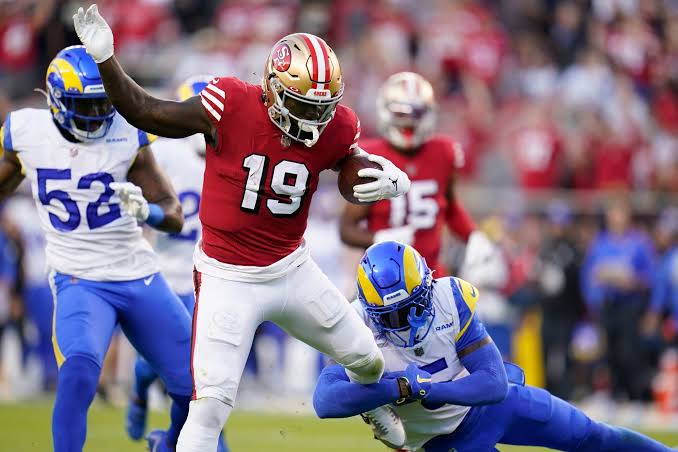
The match player stats show who dominated and who struggled during the 49ers vs Los Angeles Rams encounter.
The San Francisco 49ers opened their 2026 season with a 27-7 win over the Los Angeles Rams on Thursday night, September 10. Brock Purdy threw three touchdown passes, the ground game averaged 5.8 yards a carry, and the defense forced two turnovers while holding the Rams to a single touchdown.
Score by quarter
| Team | Q1 | Q2 | Q3 | Q4 | Final |
|---|---|---|---|---|---|
| San Francisco 49ers | 3 | 7 | 7 | 10 | 27 |
| Los Angeles Rams | 0 | 7 | 0 | 0 | 7 |
Key player contributions
| Player | Team | Contribution |
|---|---|---|
| B. Purdy | 49ers | 25/34, 205 yds, 3 TD, 1 INT, 105.6 rating |
| D. Robinson | 49ers | 39-yard TD catch, the longest play of the night |
| M. Evans | 49ers | 2-yard TD catch in Q3 |
| D. Samuel | 49ers | 15-yard TD catch in Q4 |
| E. Pineiro | 49ers | 2 of 3 field goals (20 and 56 yards), 3 extra points |
| K. Williams | Rams | 5-yard rushing TD in Q2, the Rams’ only touchdown |
| H. Mevis | Rams | Extra point |
Pineiro’s 20-yard field goal opened the scoring in the first quarter. Williams then pushed the Rams ahead 7-3 on the first play of the second quarter. San Francisco did not trail again after Purdy hit Robinson on a 39-yard touchdown down the middle with 4:35 left in the half.
Evans extended the lead in the third quarter, Samuel made it 24-7 early in the fourth, and Pineiro’s 56-yard field goal with 9:48 left capped the scoring.
Team stats comparison
| Category | 49ers | Rams |
|---|---|---|
| Total yards | 379 | 290 |
| First downs | 23 | 15 |
| Time of possession | 33:50 | 26:10 |
| Passing | 25/34, 205 yds | 17/28, 168 yds |
| Passer rating | 105.6 | 62.8 |
| Touchdown passes / interceptions | 3 / 1 | 0 / 1 |
| Rushing | 30 att, 174 yds (5.8 avg) | 29 att, 122 yds (4.2 avg) |
| Turnovers | 1 | 2 |
| Penalties | 2 for 21 yds | 4 for 43 yds |
| Fourth-down stops | 2 | 0 |
Purdy’s efficient night
Purdy completed 73.5% of his throws and averaged only 6.0 yards per attempt. The 49ers’ passing game was built on short, accurate throws that let receivers do the work. The 49ers gained 117 of their 205 receiving yards after the catch, about 57%. Their 88 total air yards were modest, and they sent eight red-zone targets toward the end zone. The offense was disciplined, and that discipline produced three touchdowns.
Purdy was intercepted once, but the mistake did not cost San Francisco in the scoreboard column.
The ground game decided the tempo
San Francisco’s 174 rushing yards produced 10 first downs and never put the offense in long-yardage situations. The longest run went for 18 yards, and the 49ers broke two tackles. The Rams ran the ball reasonably well at 4.2 yards a carry, but their passing game could not support it.
Rams’ offense stalls
Los Angeles managed a 62.8 passer rating, with seven throws charted as poor and one interception. Their longest completion was 41 yards, but the 168 total passing yards never threatened San Francisco. The Rams also lost a fumble on a reception and fumbled twice in total. They finished 0-for-0 on field goals, with all of their scoring coming from Williams’s second-quarter run.
Defense and discipline
The 49ers defense did not record a sack, but it hit the quarterback eight times, forced two fumbles, intercepted a pass and stopped the Rams on two fourth-down tries. San Francisco was flagged just twice for 21 yards, compared with four penalties for 43 yards for the Rams.
What’s next
The 49ers have gone on to beat Miami, Arizona, Denver and Seattle, and they host Washington on Monday Night Football on October 19. The Rams return to Levi’s Stadium on December 13 for the rematch.